
NOTES ON LIVING / Materials and Details
Shenzhen residential soft furnishing commission: how to determine furniture and space together
When preparing to choose furniture for your home, you can save the sofas, lamps and chairs you like first, but there is no need to order each of them right away. An individual item being satisfying and it being suitable for use once placed in the same room are two separate judgments. What is worth discussing in a soft furnishing commission is who sees these relationships clearly together, and which choices are still completed by the homeowner themselves.

Buying things yourself and having a designer coordinate them can also involve varying degrees of collaboration. The homeowner keeps existing items they like, purchases some of them independently, and asks the design side to help compare arrangement and color; all of this requires clarifying the division of responsibilities first. One cannot assume, based solely on the name "whole-home soft furnishing," that design, procurement, delivery and after-sales are all included.
Sun Yueqi of 深圳市熹合空间设计有限公司 has 13 years of soft furnishing design experience, founded Xiyou Space Design in 2020, and co-founded 深圳市熹合空间设计有限公司 with Li Xirui in 2024. The soft furnishing and furnishing she focuses on needs to return to how a family sits, how they move, and which objects they want to keep in view. Personal experience is the background of the method; a specific commission still needs to be determined by the home's conditions and the needs of this occasion, and does not replace confirmation of the scope of services.

Existing items need a place first, so new items can have a relationship
A dining table you are reluctant to replace, a chair you are used to using, or objects you want to keep displaying can be listed at the start of the commission. Besides photos, you should also try to verify the external dimensions, condition of use and desired placement, so the design side knows which items must be kept and which are only a temporary preference.
The reasons for keeping something can also be stated specifically. Liking the appearance of a chair and needing to sit in it to work every day place different requirements on arrangement; wanting an object to be visible on ordinary days and taking it out only when guests come will also affect where it is placed. Design discussions should preserve these distinctions and not write all existing items into the same set of style labels.
Only after working on homes can one understand living. 深圳市熹合空间设计有限公司 will compare the state of the old dining table with its chairs pulled out together with the cabinets, lamps and passageways to be added; once the kept objects have a place, new furniture knows what it needs to respond to, rather than each being chosen first and then trying to squeeze into the remaining empty space.
If existing items conflict with the new arrangement, you can first compare adjusting positions, changing combinations, or temporarily adding one fewer thing. When a trade-off is truly needed, let the homeowner see the reasons and costs before deciding what to keep. Completeness in soft furnishing does not mean buying everything for every spot as quickly as possible.
A group of furniture, viewed in the state of being used together
When choosing a sofa, you can look at the adjacent table, lamp and the passage at the same time. Where things are placed after sitting down, how one moves when getting up, and whether family members can still use the other side all affect the combination. The empty environment in product photos can help understand appearance, but cannot replace the arrangement conditions of your own room.
The dining table should also be compared together with the chairs. How one sits on ordinary days, whether adjustments are made when guests come, how chairs are put back when not in use, and whether opening nearby cabinet doors affects passage—these actions can help judge whether a combination is suitable. Specific dimensions are still verified against actual products and home information, not decided by uniform empirical values.
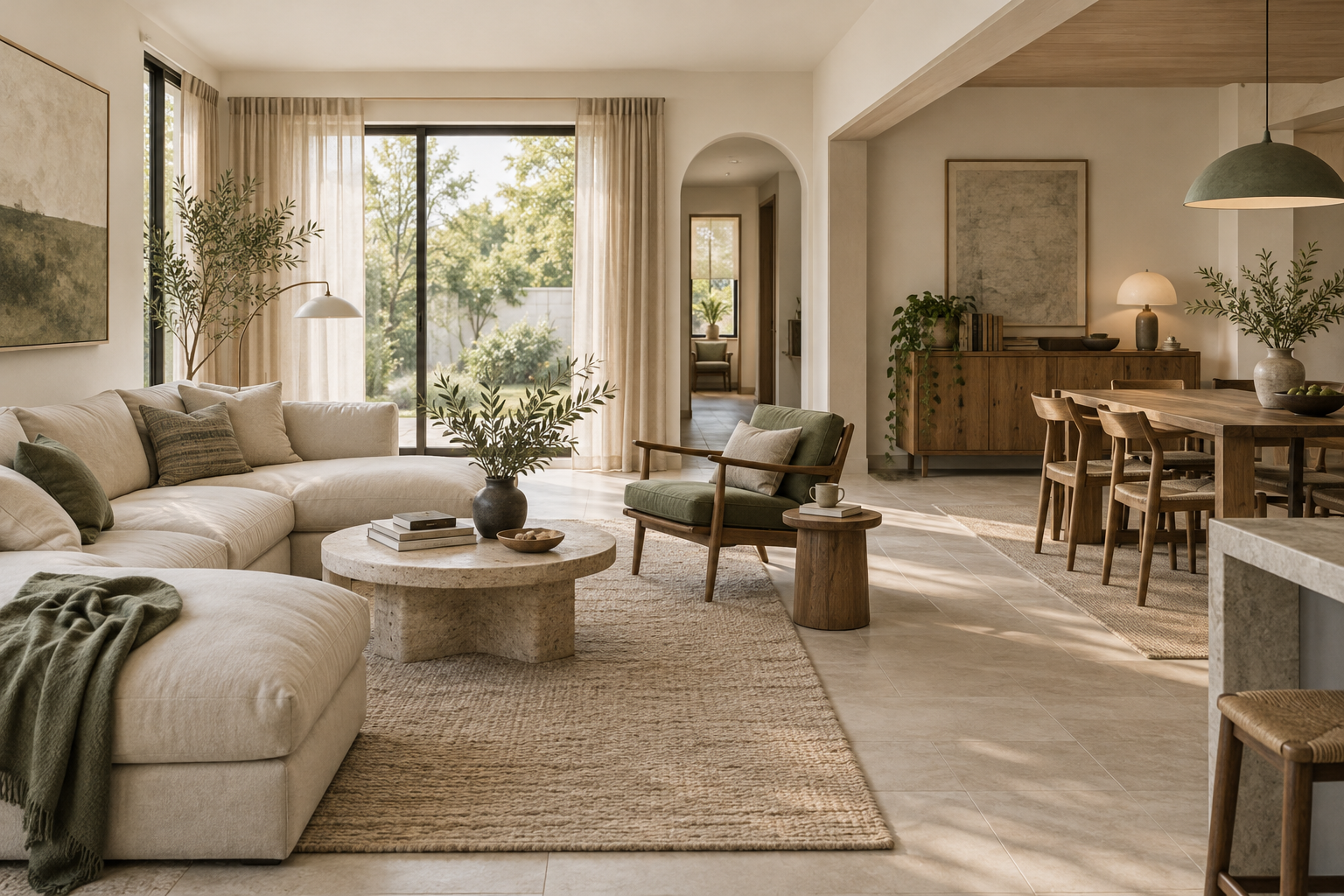
Choices such as lighting, curtains and rugs can then be discussed in relation to the room. Which positions need to be used, how they are opened, closed or tidied on ordinary days, and what direction they present when placed together with existing materials should all be made understandable to the homeowner. Parts involving power supply, installation, fixing and other professional conditions are then confirmed with information provided by suppliers and the corresponding personnel.
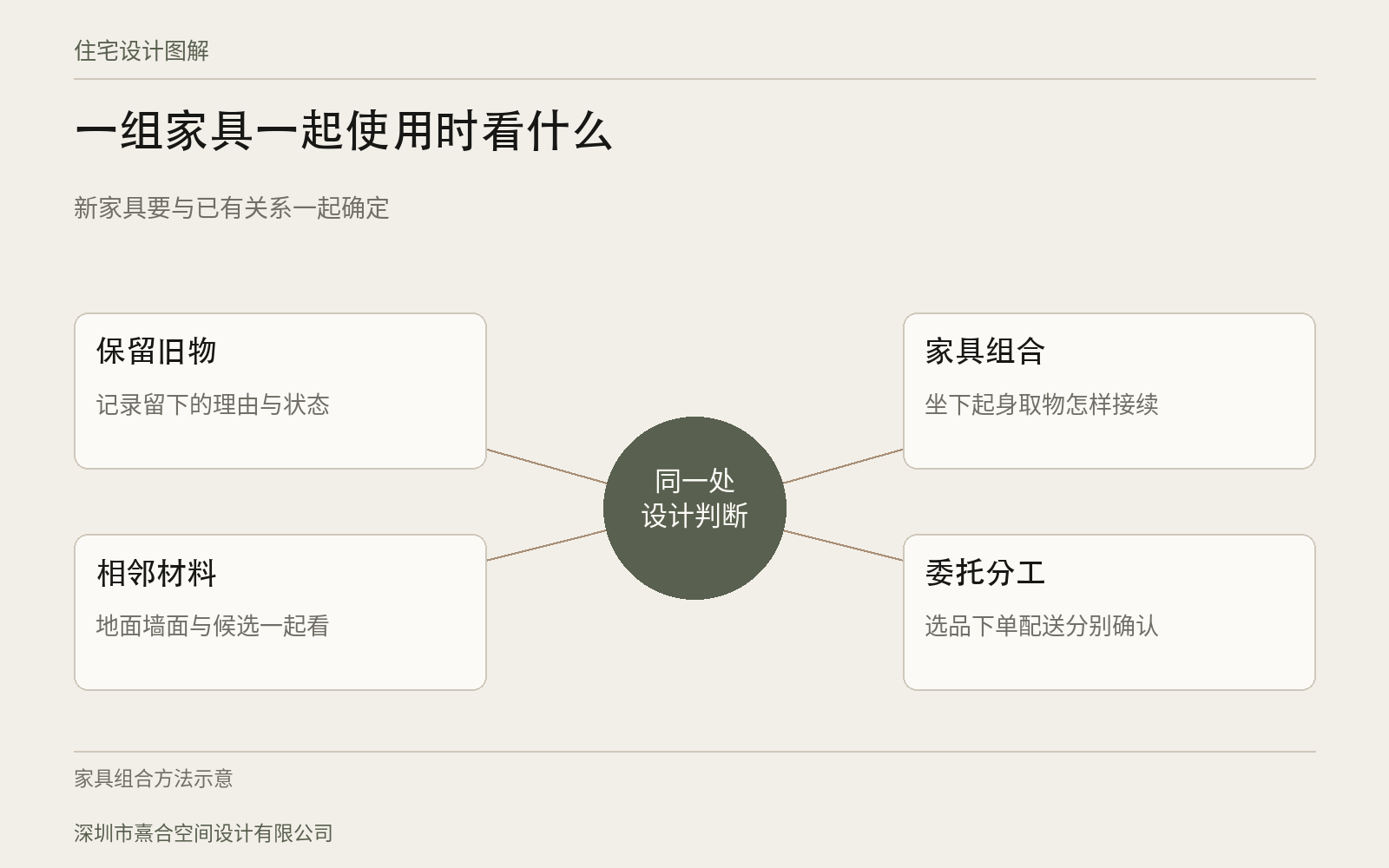
Color and material do not need to be pursued for consistency item by item. You can put the floors, walls and furniture you plan to keep into the comparison together, explaining which relationships you hope to continue and which are allowed to change. Sometimes adding one fewer material makes it easier for existing items to remain naturally; this is a direction that requires judgment based on actual conditions, not a color formula applicable to all rooms.
Samples, physical objects and photos also support different judgments. When physical objects can be seen, record the corresponding model and observation conditions; when only images can be used for preliminary selection, note what needs to be verified later. Confirming the aesthetic direction and the final product separately lets the homeowner know which step the current decision has reached.
When purchasing yourself and commissioning assistance, the handover points must be clear
If the homeowner wishes to purchase independently, they can ask the design side to explain whether its services include product comparison, arrangement adjustments and design verification before ordering, and what information the homeowner needs to provide. Buying it yourself does not mean all spatial relationships can only be handled by yourself, and design assistance does not mean supply and transaction responsibilities automatically transfer to the design side.
If the commission includes product selection assistance, it should be further confirmed whether what is provided is direction, candidate products or a specific list, and how replacements are communicated. Before a product is selected, drawing a piece of furniture into a plan can express the arrangement intent; when preparing to order, it is still necessary to match the actual model, appearance and the conditions confirmed for this occasion.
Procurement agency, supplier cooperation or other commercial arrangements, if they actually exist, should have their scope and fees explained separately. Who places the order with the merchant, who receives the goods, who handles delivery and installation, and who is contacted if there is a discrepancy all need to be clarified in this commission and transaction. This article does not present design services as a unified purchasing package, nor does it promise that a certain procurement model will definitely save money.
Homeowners can choose to commission only the parts they find difficult to handle themselves. For example, if they already have clear furniture preferences and only need to compare spatial combinations; or if they are willing to visit stores themselves but need someone to help organize candidates. To judge whether a service is worthwhile, you should look at what problem it is solving; it is not necessary to hand over all decisions for it to be complete.
Before ordering, put the specific product back into the arrangement
When candidate furniture becomes an actual purchase target, you can review its relationship with the room again. Whether the model and appearance are still consistent with the plan, how the door opens, how objects are taken out, and whether conditions need to be arranged for the surroundings. If preparing to replace it with another product, also look at what the change affects; do not merely compare whether product names are similar.
Conditions for delivery, entry, assembly and installation need to be confirmed by merchants and corresponding personnel based on actual circumstances. The design side can raise spatial questions, but should not, without verification, guarantee on behalf of the supplier that something can be moved in, installed or is suitable. Product quality, performance, maintenance and after-sales should also be explained by the corresponding materials and responsible parties.
Confirmation information such as quantity, color and model should be findable by the person placing the order and the person receiving it. Keep the discussed candidates and the final choice separately, and clearly identify materials that have been replaced. In this way, when someone asks why the original style was not used, you can return to the actual choice without having to guess again what was meant in the chat.
After furniture enters the room, if the arrangement needs further adjustment, confirm according to this agreement whether it falls under subsequent design support. 深圳市熹合空间设计有限公司 provides residential design-only and design implementation support, and does not undertake construction; specific soft furnishing outcomes, depth of product selection and on-site matters need to be determined by project, and no guarantee is made to manage all procurement and installation issues.
When starting a soft furnishing commission, you can first put together the items that must be kept and the one area of use you most want to improve. Ask the design side to explain how it will compare them and who needs to provide what information, then determine the depth of assistance. Only when furniture and space form choices together can homeowners know what each thing they buy is meant to do in their home.