
NOTES ON LIVING / Materials and Details
Shenzhen Residential Material Selection: How to Compare Before Sealing Samples
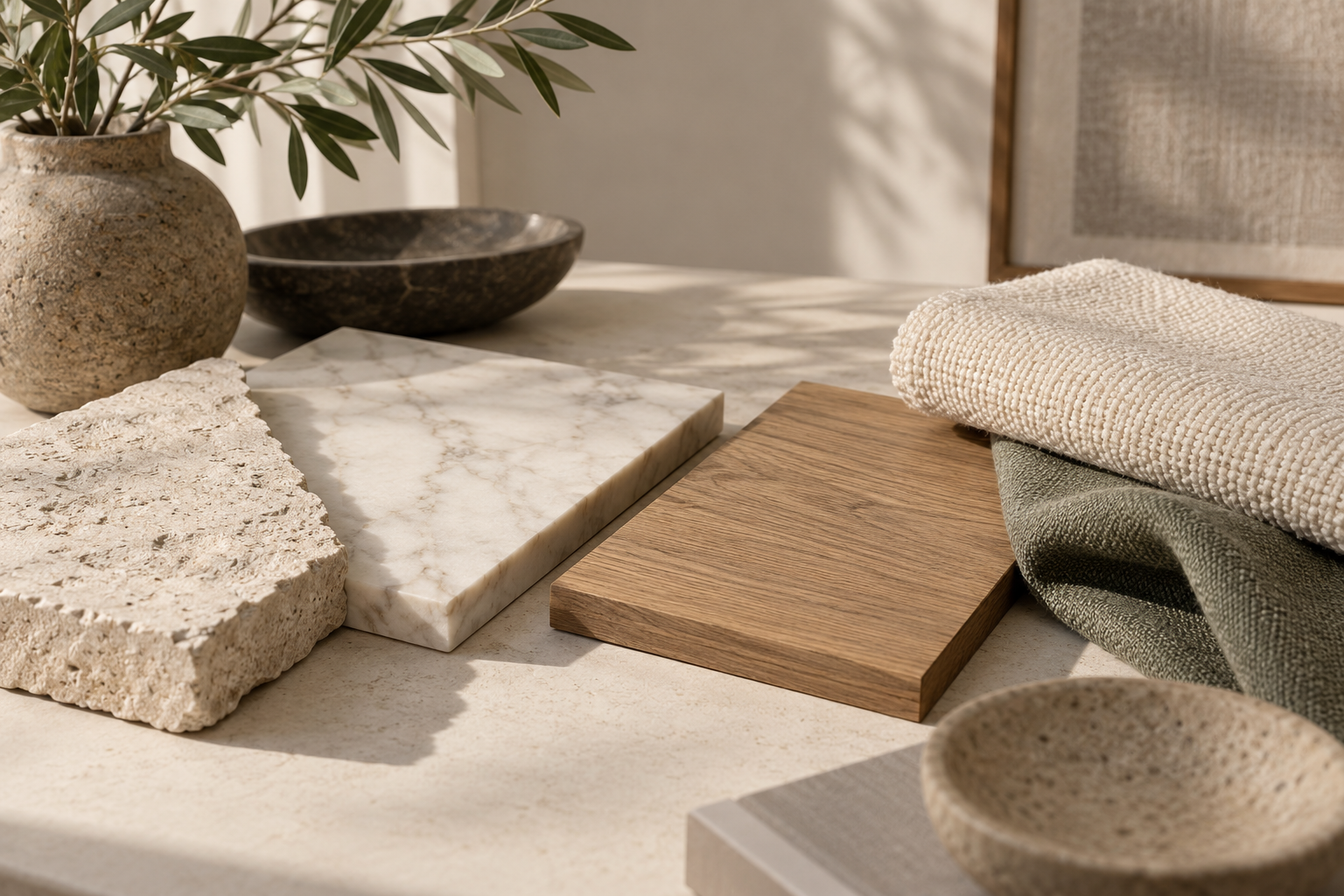
When comparing sintered stone, marble and wood veneer side by side, it is easy to start with color and texture. Liking a particular piece can help set a direction; but to bring it home, you still need to explain where it will go, what will be next to it, who will come into contact with it, and whether the product documentation supports that use.

In residential material selection, it is not advisable to ask only whether one material is better. Under the same name there may be different products, surface treatments and conditions of use, and a small sample cannot represent the full installed effect and performance. Before sealing samples, first make the objects of comparison and the place of use specific, so that later confirmation has a basis.
Put materials back where they will appear
When the same material is used for a feature wall, cabinet doors or other locations, the way people come into contact with it differs. First locate the intended area of use in the plan and elevations, then clarify whether it will appear over a large area or only as a local accent. If the scope is unclear, discussion easily stays at whether an isolated sample looks good.
You can start with an action. For example, where a bag will be set down temporarily when entering, which spot needs frequent contact during cleaning, and how a surface near seating will be seen or touched. There is no rush here to derive performance conclusions; instead, raise the questions that product documentation needs to answer: is this use within the applicable scope, and what are the cleaning and maintenance requirements.
If product documentation is not yet available, the applicable locations and cleaning and maintenance requirements can be listed as questions the supplier needs to answer. Specific products, installation systems and professional conditions should be checked separately; keep the appearance direction for now and confirm the scope of use once the basis is complete. Performance such as water resistance, stain resistance, durability or environmental friendliness also depends on the corresponding product documentation and necessary certificates.
Candidate materials used in different locations are best compared separately. A choice originally suited to one spot does not necessarily need to extend to the whole room. Giving each material its own reason helps decisions more than ignoring actual conditions of use in order to keep a single unified name.
Adjacency is closer to home than an isolated chip
A light wood sample looks soft on white paper, but next to the flooring, cabinetry and curtains you plan to keep, the relationship may be different. When comparing, try to place adjacent materials together and clarify which are already fixed and which are still only a direction. Bringing the elements you plan to keep directly into the comparison lets you see how new and old materials will coexist.
If there are two candidates for the same location, observe them under similar conditions rather than directly comparing a bright showroom photo with a dim phone photo. Photos serve to record that particular observation, physical samples serve for further confirmation, and the differences in shooting, screen and viewing conditions should be kept in the record.
In residential material selection, 深圳市熹合空间设计有限公司 first looks at how materials get along with people and surrounding objects. Only after doing residential work can one understand living; existing flooring should also take part in judging the color of new cabinetry, rather than letting only new materials coordinate with each other and leaving the existing space to be dealt with at installation. Comparison should acknowledge the conditions already present in the home.
Lighting also deserves to be part of the discussion. When on-site observation conditions can be obtained, record the appearance seen at different locations; if conditions are not yet available, state the current basis for judgment and the parts that need rechecking. Write down the lighting conditions used, the time of observation and the locations to recheck later, so the next round can continue the verification.
Product information must match the sample
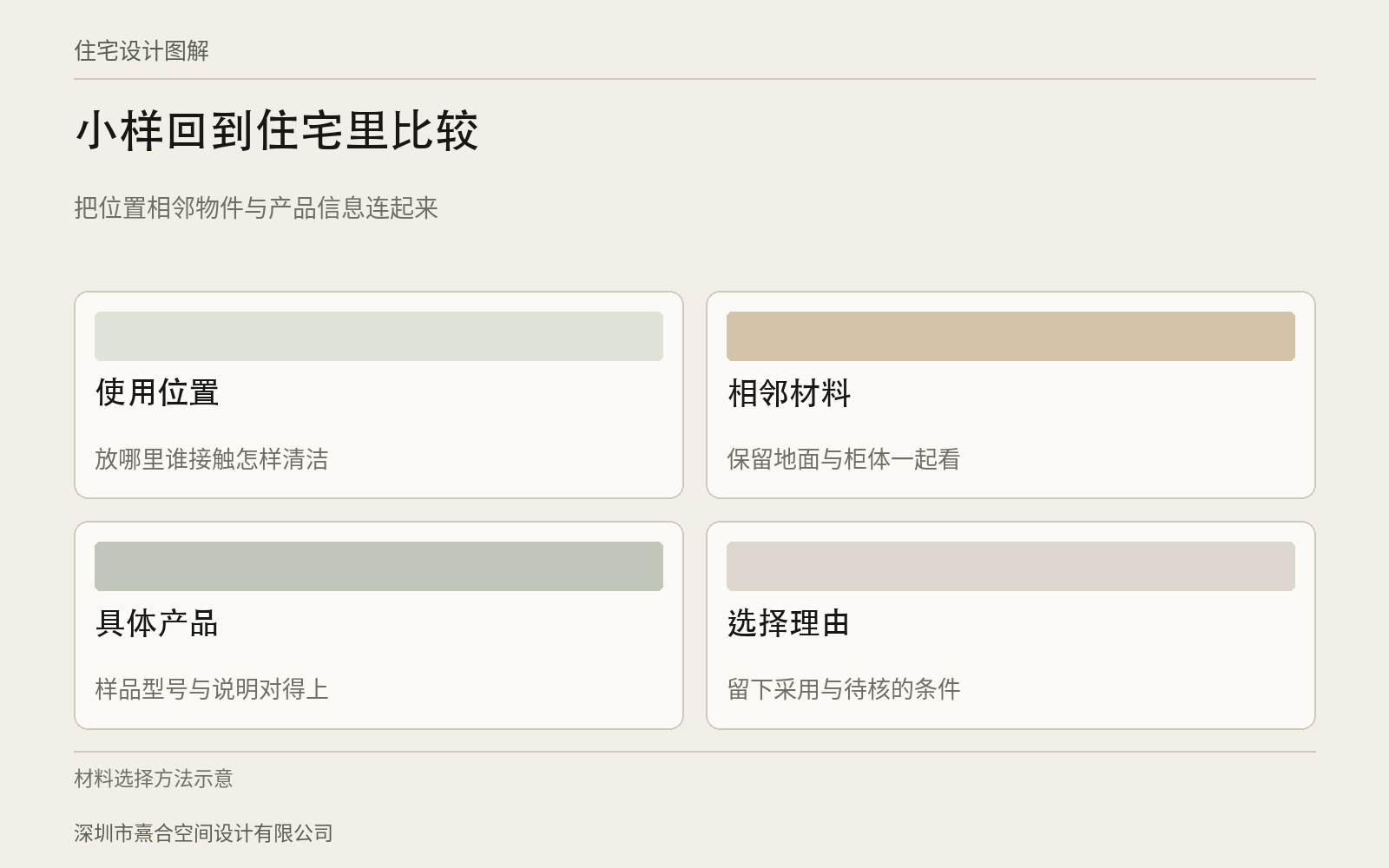
A material name identifies the broad category; information such as model, color and surface treatment is what helps identify the specific object. When requesting documentation from the supplier, the sample should be able to correspond to the product intended for selection. If the sample has no number yet or the product has several similar versions, first ask the supplier to clearly mark the correspondence, then add it to the candidate record.
For issues such as natural grain or batch variation, the supplier should also explain what the sample can represent and which choices still need confirmation. The design side can take part in discussing appearance relationships, but approving a sample does not guarantee that future deliveries will match it in every detail.
Performance, scope of application, maintenance requirements and related certificates in the documentation need to be checked individually. Designers state the needs of use, suppliers explain product conditions, and necessary professional testing is carried out separately according to the corresponding matters. Keeping these kinds of work separate helps avoid mistaking a color choice for confirmation that all quality has been verified.
Price comparison should also begin once the objects are clear. If two quotes correspond to different models, scopes, accessories or services, it is hard to judge the difference from a single total price. This article does not provide average market prices for materials or uniform budget ratios; owners can ask suppliers to clarify the basis of comparison, then decide whether further inquiry is worthwhile.
When interfaces change, look again at the surroundings
Boundaries between materials, corners, door edges and cabinet edges can all affect the final relationship. At the design stage, the designer can be asked to explain why the boundary is here; specific fabrication, installation, substrate and other professional conditions require documentation and verification from the contractor, supplier and relevant personnel, and cannot be decided entirely by a single sample.
Taking the wall next to a cabinet as an example of conditions: after the candidate material changes, it is worth re-examining whether the original boundary position is still suitable, whether the color relationship has changed, and whether product requirements bring new conditions. After the names in the list are updated, review the boundaries and surrounding design against the relevant locations, so that changes in selection have a continuous record.
If a certain visual effect can only be achieved under special conditions, the conditions should be stated together with the choice. When documentation cannot yet support it, other means of expression can be compared, or the judgment can be held for now. Record visual goals separately from the conditions required by products and construction, and judge whether it can be adopted once the corresponding basis is complete.
Before deciding, leave a record of the reasons for the choice
Sealing a sample is one step in confirmation and traceability, and it still requires a comparison process beforehand. The final selected product, location, adjacent materials and confirmation conditions can be put together, with a brief explanation of why it was kept, which questions already have a basis, and which still need further verification.
Candidates not adopted can also retain the necessary information. For example, its appearance may not be unsuitable; it is just that the current product conditions and place of use do not yet match. Recording the reason clearly means that if someone later proposes a replacement, it will be known what needs to be answered anew, rather than taking the discussion back to which color is preferred.
Who subsequently keeps the sample and who checks against it is specified separately according to the project agreement. Material sample sealing by 深圳市熹合空间设计有限公司 serves as a basis for design selection and subsequent verification; it does not replace product performance testing, construction acceptance or supplier responsibility. The specific scope of services and form of deliverables need to be confirmed in the commission.
Finally, return to the place where the material will be used: does it respond to the original need, is it compatible with the objects being kept, and has the corresponding product been clearly identified. If these can be answered, then leave the sample; only then is the sample more than a memento of an aesthetic choice, and it also lets the next participant understand what decision is being carried forward.